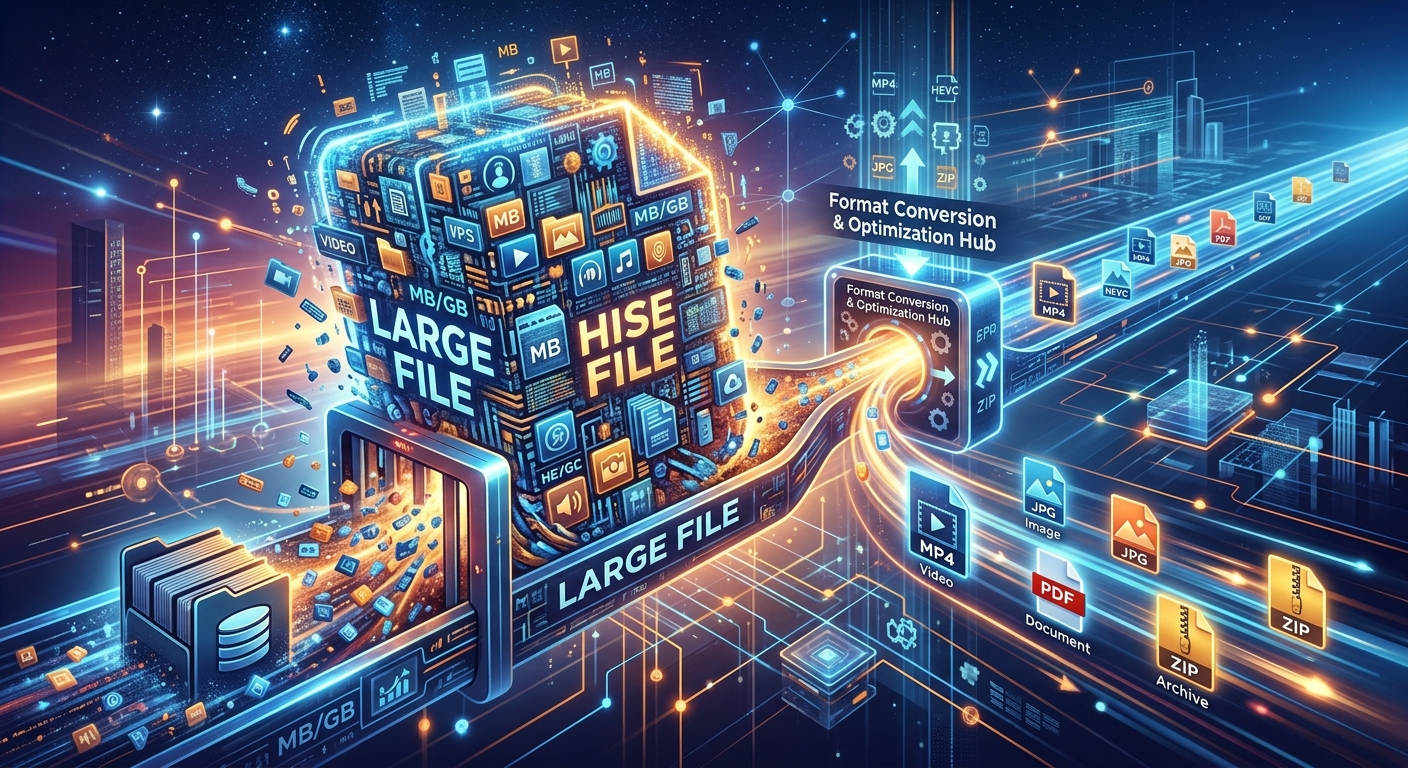
You hit send. The upload bar barely moves, then an error message appears: file too large. Most people either give up or blindly compress whatever they have and hope for the best. But file size is rarely random. It comes from specific, knowable causes, and once you can name them, fixing the problem becomes far more straightforward than it looks.
File size comes down to four factors: the container format, the codec doing the actual compression, resolution or sample rate, and whether that compression is lossy or lossless. Switching from PNG to WebP, H.264 to H.265, or WAV to Opus can cut files to a fraction of their original size, often with no visible quality difference. This article breaks down each driver and closes with a reference table so you can make format decisions at a glance, without guesswork.
Container Formats and Codecs Are Not the Same Thing
This is where most people get confused, and it matters. A container is the wrapper that holds your media. MP4, MOV, AVI, MKV , these are containers for video. MP3, WAV, AAC , containers for audio. They carry the data and metadata, but they say almost nothing about how the content inside was actually compressed.
The codec is what does the compression work. An MP4 file can contain H.264 video or H.265 video. Same container, very different file sizes. Converting a file from one container to another without changing the codec can move the needle barely at all. If you want a real size reduction, the codec is where to start.
Resolution feeds directly into file size too. A 4K frame holds four times as many pixels as a 1080p frame, which means roughly four times the data to store and transfer. Bitrate, measured in kilobits or megabits per second, sets the data budget for video and audio. Higher bitrate means better quality and a larger file. And compression type, either lossy or lossless, determines whether data gets permanently discarded or mathematically preserved intact.
PNG to WebP: Where Image Sizes Drop the Furthest
PNG is a lossless format. Every pixel is stored exactly, which is great for image accuracy and difficult for file size. A high-resolution PNG screenshot or product photo can easily hit several megabytes. WebP, developed by Google as a modern image format, handles both lossless and lossy encoding with noticeably better efficiency than either PNG or JPEG.
For lossless images, WebP typically produces files about 25 percent smaller than equivalent PNG. For lossy images, WebP beats JPEG by around 25 to 35 percent at comparable visual quality. That difference compounds fast across batches. A folder of product images converted from PNG to WebP can shrink from 80MB to under 50MB without any visible degradation.
The gain comes from how WebP encodes blocks of pixels. It uses predictive coding and more advanced entropy compression than PNG's older DEFLATE-based approach. Google's WebP compression study demonstrates these efficiency gains across large image datasets, which gives the format a strong and well-documented track record for web use.
H.264 vs. H.265: The Codec Switch That Halves Video Files
H.264, also called AVC, has been the dominant video codec for over a decade. It compressed video far better than its predecessors and became the default for streaming, recording, and sharing. H.265, known as HEVC, built directly on that work and improved efficiency substantially. At equivalent visual quality, H.265 produces files roughly 40 to 50 percent smaller than H.264.
That improvement is not abstract. A 500MB H.264 video re-encoded to H.265 might land at 250MB or less. That can mean the difference between a file that fits under a messenger's size cap and one that gets rejected outright.
The trade-off is encoding time. H.265 is computationally heavier, so conversion takes longer. But for a one-time format change before sharing, that wait is almost always worth it. Bitrate reduction helps further. Dropping bitrate modestly on a video destined for phone or laptop playback often produces no visible change in quality while cutting the file noticeably.
WAV to Opus: Why Uncompressed Audio Has No Place in a Shared File
WAV files store raw, uncompressed audio. Every sample is recorded at full resolution without any attempt to shrink it. That fidelity is valuable in a recording studio during editing, but it creates enormous files with no real advantage once you're sending something to another person.
One minute of CD-quality WAV audio takes around 10MB. A 45-minute podcast episode stored as WAV can exceed 450MB. For sharing over email, a messaging app, or cloud storage with limited space, that is simply impractical.
Opus is the right replacement for nearly every sharing scenario. Developed jointly by the Xiph.Org Foundation and IETF, the format's design is documented in the Opus codec RFC, which details how it achieves high perceptual quality at very low bitrates. At 128 kbps, an Opus file is largely indistinguishable from the original WAV for most listeners. At 64 kbps, it still handles speech well. A WAV file at CD quality runs at 1411 kbps. An Opus file at 128 kbps is nearly twelve times smaller, with quality that most people cannot tell apart from the original.
MP3 remains more universally supported on older hardware, but Opus has closed the compatibility gap significantly. Chrome, Firefox, and Edge all handle Opus natively, making it the stronger choice for files shared online.
Why Re-Compressing Lossy Files Causes More Harm Than Good
One of the most common size-reduction mistakes is taking an already-compressed file and compressing it again in the same lossy format. This feels logical at first. If the JPEG is too large, make it a smaller JPEG. But lossy compression works by permanently discarding data based on assumptions about what human perception will not notice. When you compress a JPEG again, the encoder is working from data that has already been degraded, and it applies new assumptions on top of those existing errors.
The result is artifacts that compound with each pass. Colors shift, edges blur, and block patterns appear in areas of smooth color. Quality drops faster than expected because the encoder is no longer removing genuinely redundant data. It is making guesses about a file that has already been guessed at once.
The clean path is always to start from the original lossless source. Convert from the master PNG, the raw recording, the uncompressed rendered video. If that master is gone, accept the quality level you have and convert once, aiming for the best possible trade-off at that single step rather than stacking multiple rounds of degradation.
When a Converted File Still Exceeds the Limit
Format optimization takes most files a long way. But some simply cannot be compressed far enough through codec changes alone. A two-hour raw video archive, a folder of high-resolution scanned documents, a full audio project with multiple tracks , these have size floors that no conversion will meaningfully shift. At that point, the practical answer is to move from optimization to delivery.
Rather than chasing diminishing returns on compression, you can send large files through a platform built for exactly that purpose. File-sharing tools bypass attachment caps entirely, handle transfers reliably, and keep the process simple. The two-step approach , optimize the format first, then use a sharing tool if needed , keeps both steps clean and avoids the trap of compressing a file into an unusable state just to squeeze it past an arbitrary limit.
Why Messenger and Email Caps Feel Arbitrary but Are Not
Gmail caps attachments at 25MB. WhatsApp limits files to much less for most types. These limits exist because general-purpose communication infrastructure is not designed for large file storage and routing. Storing gigabytes of attachments per user per day is expensive, and delivering them reliably adds latency to the entire system. The caps are engineering decisions, not bureaucratic ones. Format optimization helps you get under them more often. A dedicated sharing tool handles the cases when you cannot.
Format Choices by File Type
The table below maps common legacy formats to their modern alternatives, with realistic size reductions you can expect after conversion. Figures assume similar quality targets and typical content , results vary based on source material, but the ranges reflect real-world outcomes across a wide range of files.
Legacy Formats vs. Modern Alternatives and Typical Size Reductions
| File Type | From Format | To Format | Typical Reduction | Compression Type |
|---|---|---|---|---|
| Image | PNG | WebP (lossless) | ~25% smaller | Lossless |
| Image | JPEG | WebP (lossy) | 25, 35% smaller | Lossy |
| Video | H.264 (AVC) | H.265 (HEVC) | 40, 50% smaller | Lossy |
| Video | AVI (uncompressed) | H.265 MP4 | 85, 95% smaller | Lossy |
| Audio | WAV | Opus | 80, 92% smaller | Lossy |
| Audio | WAV | FLAC | 40, 60% smaller | Lossless |
| Audio | MP3 | Opus | 30, 40% smaller | Lossy |
Format First, Then Deliver: The Complete Picture
The most common mistake is treating file sharing as one problem with one solution. It is actually two separate steps that benefit from different approaches. The first step is making the file as small as practical through format decisions. That means matching the codec to the content, choosing lossy compression only when quality loss is acceptable, and always starting from the cleanest source available.
The second step is delivery. Once the file is in its optimal format, you check whether it fits the channel. If it does, great. If it does not, the answer is a sharing tool designed for large files, not another round of compression that trades quality for a few extra megabytes of headroom you may not even gain.
Knowing what actually makes a file large removes the guesswork from both steps. Container, codec, resolution, bitrate, compression type , these are the five levers. Adjust the right one for your file type, convert once from a clean source, and the size problem resolves itself more often than not. When it does not, you now know exactly which tool picks up from there and why.